Placing You at the Centre of Care

Search

Neurotechnology

ABLE Exoskeleton

The UK’s first ABLE Exoskeleton enables assisted walking training by combining powered support with active patient participation to improve mobility and independence.
What is the ABLE Exoskeleton?
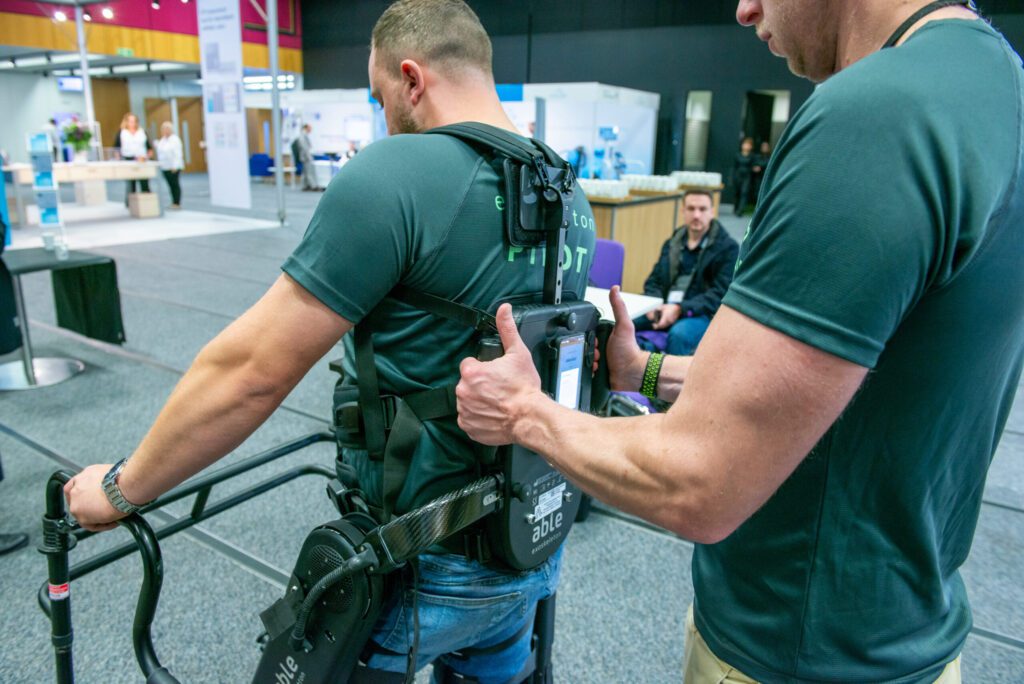
The ABLE Exoskeleton, developed by ABLE Human Motion, is a hip–knee powered wearable device designed for individuals with lower-limb mobility impairments, including those resulting from spinal cord injury. It is designed to be lightweight and adjustable, allowing clinicians to tailor it to each user’s body size and rehabilitation needs. Developed in collaboration with clinicians and patients, it provides powered assistance to support upright activities such as standing, walking, turning, and sitting, and is typically used as part of a multidisciplinary rehabilitation programme rather than in isolation.
What is a robotic exoskeleton and how is it useful in rehabilitation?
A robotic exoskeleton is a wearable device that uses powered joints and control systems to assist movement of the body, particularly the limbs. In rehabilitation, exoskeletons are used to support individuals with mobility impairments by enabling them to stand and walk with guided assistance. This allows for repetitive, task-specific training in an upright position, which can help improve strength, coordination, balance, and gait patterns while also promoting active participation and engagement during therapy.
The ABLE Exoskeleton is designed for individuals with neurological conditions affecting lower-limb function, particularly spinal cord injuries. It assists with standing, walking, turning, and sitting, enabling users to engage in structured rehabilitation activities. Supporting upright mobility helps facilitate weight-bearing, balance training, and postural control, while also contributing to broader health benefits such as improved cardiovascular function, flexibility, and reduced spasticity. It is suitable for integration into both intensive rehabilitation programmes and ongoing outpatient therapy.

The ABLE Exoskeleton uses powered hip and knee joints with backdrivable actuator technology to assist and guide lower-limb movement. This design helps produce a more natural walking pattern while still allowing the user to participate actively in the movement. The device is adjustable to accommodate different body sizes and clinical requirements, and its lightweight construction allows clinicians to fit and manage it efficiently during therapy sessions. It also supports controlled transitions such as turning and sitting down, which are important for functional mobility training.

At Hobbs Rehabilitation, the ABLE Exoskeleton is incorporated into multidisciplinary rehabilitation programmes as part of a personalised treatment plan. Clinicians use the device alongside conventional therapy to support lower-limb training goals. Its adaptability allows therapy to be tailored to each individual, progressing exercises based on ability and recovery stage. The exoskeleton is used to provide structured, repetitive, and goal-oriented training aimed at improving mobility, independence, and overall quality of life within both outpatient and intensive rehabilitation settings.

Let's Get Started

The equipment is available at Hobbs Rehabilitation Intensive Neurotherapy Centre (Bristol), South East (Liss), Winchester, and Chedington – find your nearest centre.
Alternatively, call us on 01962 779796 to talk with our team or fill out our enquiry form on our contact page.

We accept self-referrals and referrals from Medico-Legal, health and social care professionals and the charity sector.

Please note: While the locations listed show where each device is normally available, some smaller pieces of equipment are occasionally shared between centres. Larger devices remain at their designated locations. For specific requests, please contact us, and we will advise on availability or alternatives.

Shape the Future Through Clinical Trials

Join our research trials - open to all, including non-Hobbs patients.

What Our Patients Say

Don’t just take our word for it – take theirs