Placing You at the Centre of Care

Search

Case Study

Marcus | Guillain-Barré syndrome | Bristol

April 29, 2026

Marcus is a 24-year-old who developed the rare neurological condition Guillain-Barré syndrome (GBS) in February 2024. GBS is a serious autoimmune disorder in which the immune system attacks the peripheral nerves, often triggered by a preceding infection.
To further complicate his journey, Marcus experienced a relapse of cancer following his GBS diagnosis. Despite this additional challenge, he is now in remission, demonstrating significant resilience throughout his recovery.
Following the acute phase of his illness, Marcus made good progress during his inpatient stay within the NHS. However, after returning home, the level of therapy input reduced, and his progress began to plateau then decline. Determined to continue improving, Marcus sought further specialist rehabilitation and first attended Hobbs Rehabilitation in Bristol in September 2025, following referral from another private neurological provider.
At this stage, Marcus’ GBS had significantly impacted both his upper and lower limbs, affecting his strength, coordination, and overall independence. He initially attended intensive physiotherapy and occupational therapy sessions lasting up to two hours, two to three times per week. As his rehabilitation progressed, this was adapted to more focused sessions, with an emphasis on improving his walking ability and functional independence, alongside the use of splinting.
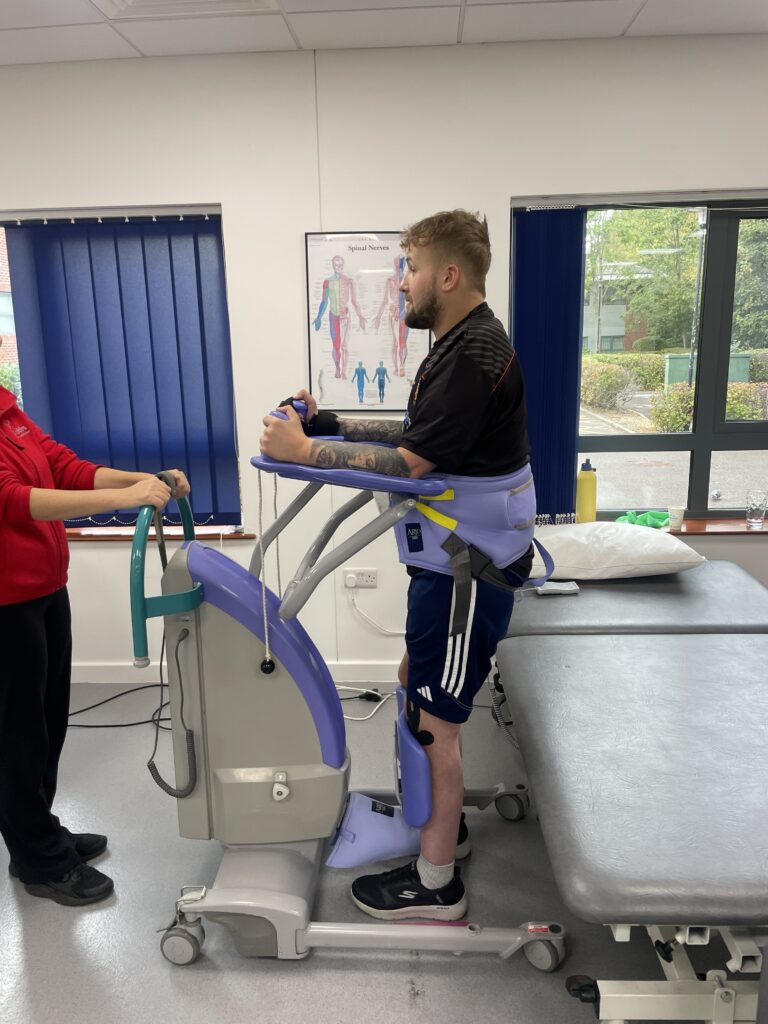
On admission, Marcus presented with complex physical challenges. He required full assistance from two people to stand using a Sara Arjo aid. There was no active movement in his right leg, alongside significant weakness in his left leg. He also demonstrated reduced core strength and was spending prolonged periods in bed due to fatigue and reduced mobility. Activities of daily living – including washing, dressing, cooking, and mobilising around his home – required substantial support.
Marcus’ primary goal was to regain as much functional independence as possible, with a particular focus on returning to standing and walking.
His rehabilitation programme was carefully tailored to address these goals. A key focus was on rebuilding core strength and postural control, forming the foundation for functional movement. Upper limb rehabilitation combined conventional physiotherapy/occupational therapy techniques with technology-assisted interventions to improve strength, coordination, and dexterity.
Lower limb rehabilitation centred on activating his right leg and strengthening his left through targeted exercises, including resistance training with weights and therabands, alongside structured standing practice. To support this, Marcus utilised specialist equipment such as the Andago, Lexo, and Sara Stedy systems, enabling safe practice of standing balance and early gait re-education.
Splinting was introduced at the start of this year to support wrist positioning and enhance hand function, enabling greater participation in daily activities. In addition, joint working with Dorset Orthotic Clinic led to the provision of front-loading ankle-foot orthoses (AFOs), which played a key role in stabilising his lower limbs and facilitating progression into walking.
Through consistent effort and specialist input, Marcus has made significant progress. He is now able to stand from a raised surface with supervision only and has regained strength in both his upper and lower limbs. With the introduction of AFOs, he is able to walk short distances using a wheeled Zimmer frame in both clinical and home environments.
His functional ability has also improved, including increased use of his right hand – demonstrated by his ability to hold a water bottle – representing an important milestone in his independence.
Marcus continues to work towards improving upper limb strength for daily activities, as well as increasing his standing endurance and postural control to further progress his mobility.
Reflecting on his journey, Marcus recently shared, “This is the most I’ve been able to walk in two years,” highlighting the extent of his progress to date.
Marcus’ story is one of determination, resilience, and steady progression. Despite facing multiple significant health challenges, he continues to work towards regaining independence and returning to the activities that matter most to him.

Main Areas Affected

Impairments: general deconditioning; reduced postural control; varying weakness in shoulders, wrists and legs both sides; apprehension in left knee, due to previous injury; reduced ROM at ankles; self-reported reduced attention and memory problems

Activity limitations: toileting, cooking, cleaning, washing and dressing, getting around the house

Participation restrictions: unable to participate in hobbies, such as rugby or playing Xbox; requiring assistance for most personal and domestic tasks, difficulties to access a working environment

Functional Ability on Admission

On admission, Marcus required full assistance from two people to stand using a Sara Stedy aid. He had no active movement in his right leg and significant weakness in his left, alongside reduced core strength. His mobility was extremely limited, resulting in prolonged periods spent in bed. He was dependent on others for most activities of daily living, including washing, dressing, cooking, and moving around his home.

Hobbs Rehabilitation Input

•Intensive physiotherapy and occupational therapy (initially 2–3 sessions per week, up to 2 hours)
•Core strengthening and postural control training
•Upper limb rehabilitation (conventional therapy and technology-assisted interventions i.e. armeospring pro)
•Lower limb rehabilitation focusing on right leg activation and left leg strengthening
•Progressive resistance training (weights, therabands)
•Supported standing practice and balance training
•Use of specialist equipment: Andago, Lexo, and Sara Arjo
•Gait re-education and walking practice
•In house wrist splinting to support hand function and strength
•Joint working with orthotic specialists for provision of ankle-foot orthoses (AFOs) with dorset orthopedic orthotic
•Ongoing review and adaptation of therapy programme to support functional independence

Functional Ability on Discharge

Marcus has made significant progress since starting rehabilitation. He has regained strength in both his upper and lower limbs, including improved activation in his right leg and increased strength in his left. He is now able to stand from a raised surface with reduced assistance and has progressed to walking short distances using a wheeled Zimmer frame with the support of ankle-foot orthoses.
His upper limb function has also improved, with increased hand strength and dexterity – demonstrated by his ability to hold objects such as a water bottle. Overall, his endurance, balance, and confidence have continued to improve, enabling greater independence in daily activities.

Outcomes

Goals

increase upper limb strength and endurance, to enhance performance in ADLs, particularly
Achieved
Improve standing endurance and postural control, with minimum-to-moderate support
Achieved
Long-term aim of readiness for gait re-education – and potential return to walking
In Progress

Testimonial

The most I’ve been able to walk in 2 years!

Share this: