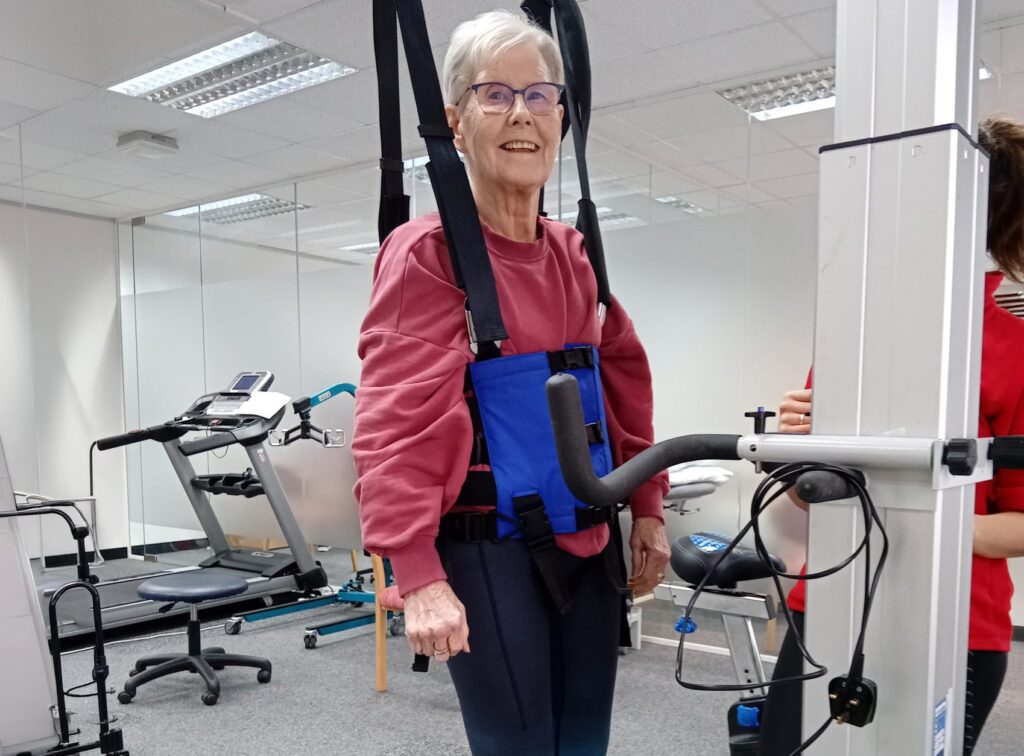
Angela was a strong, very independent lady, who had been caring for her husband who was struggling with Parkinson’s, then suffered a more significant stroke at the end of 2026. She was admitted to hospital at QA and went through the stroke rehabilitation pathway. When she reached out to Hobbs for support, she was walking short distances, but unable to engage in functional activities at home, and struggling with significant levels of fatigue.
Angela has worked hard, and made some real changes during her journey this year, despite some further health challenges which caused temporary set- backs.
Angela has been dealing with a lot over the past year, losing her husband, moving house to live with her daughter and daughter’s partner in Reading (over an hour from original home setting) and losing several friends over the year.
●L sensation impairment. For all sensory stimulation, including light touch, proprioception and temperature
●Pain- through L ankle and shin, tending to present with hyper-reactivity (heightened reflexes especially withdrawal response.
●L side strength deficit, more proximally than distally
●Tonal changes, resulting in hypertonia through hip flexors, ankle inverters and dorsiflexors.
●Stiffness and lack of flexibility at both muscle and joint level, through spine and shoulders, as well as hips (especially into external rotation and abduction)
●Difficulties with selective activation of muscles or muscle groups
●Mild shoulder pain, and lower back pain.
●Postural changes, falling into significant amounts of kyphosis and posterior pelvic tilt. Difficulties in raising head against gravity
●Fatigue and lack of exercise endurance.
●Altered gait pattern- flexor gait pattern
●Physiotherapy – initially 3 times per week, weaned down to twice per week. Had long break between these bursts when she went to visit family through the summer, and was moving house.
○Graded exercises to progress strength, balance and flexibility. Support for family and Angela to integrate these into a routine at home
– Postural re-education, including exploration of movement within different postural sets (4 point kneeling, 2 point kneeling, sitting or standing) and focus on cervical strength and deep neck flexor strengthening.
– Exploration of gait re-education
– Dual tasking practice
– Dexterity and coordination exercises for upper limb
– Sensory re-education and guidance, including vibration, light touch and temperature to help reduce the hypersensitivity of her left leg and foot.
– Trial with FES, however this was too uncomfortable to tolerate at this point
●Group exercise- this worked well for Angela as she was able to support others and responded well in a more competitive environment.
●Occupational Therapy
– Home visit to review environment
– Support to gradually integrate more cooking activities into the routine/ weekly plan
– Support to empower family members to encourage Angela to engage in more functional tasks at home
– Fatigue management
●Neuro Psychology- burst of 2 months of therapy to support with grief management, and help navigate emotions brought up by the upheaval and move from Hawkley to Reading.
●Referrals from Hobbs into the community for spasticity review, and consideration for medical interventions.
●Review in clinic for consideration of more bespoke orthotic- Angela declined this due to them being uncomfortable in the shoes.
●Assessment using the smart orthotic from Agilik with good effect (too expensive to purchase independently)
●NeuroTechnology:
– Use of FES for ankle movement, more sustained stretch
– Vibration pads to help reduce tone
– OMEGO to increase endurance, explore more ballistic power, and to encourage more knee extension during weight transfer.
● Walking insider using a 4 wheeled walker independently, also able to walk with just handheld support and an AFO in situ at ankle
● Able to manage stairs- FORWARDS!
● Returned to knitting
● Car transfer independently (support to open the day)
● Toileting independently
● Putting her boxia on independently
Don’t just take our word for it – take theirs.